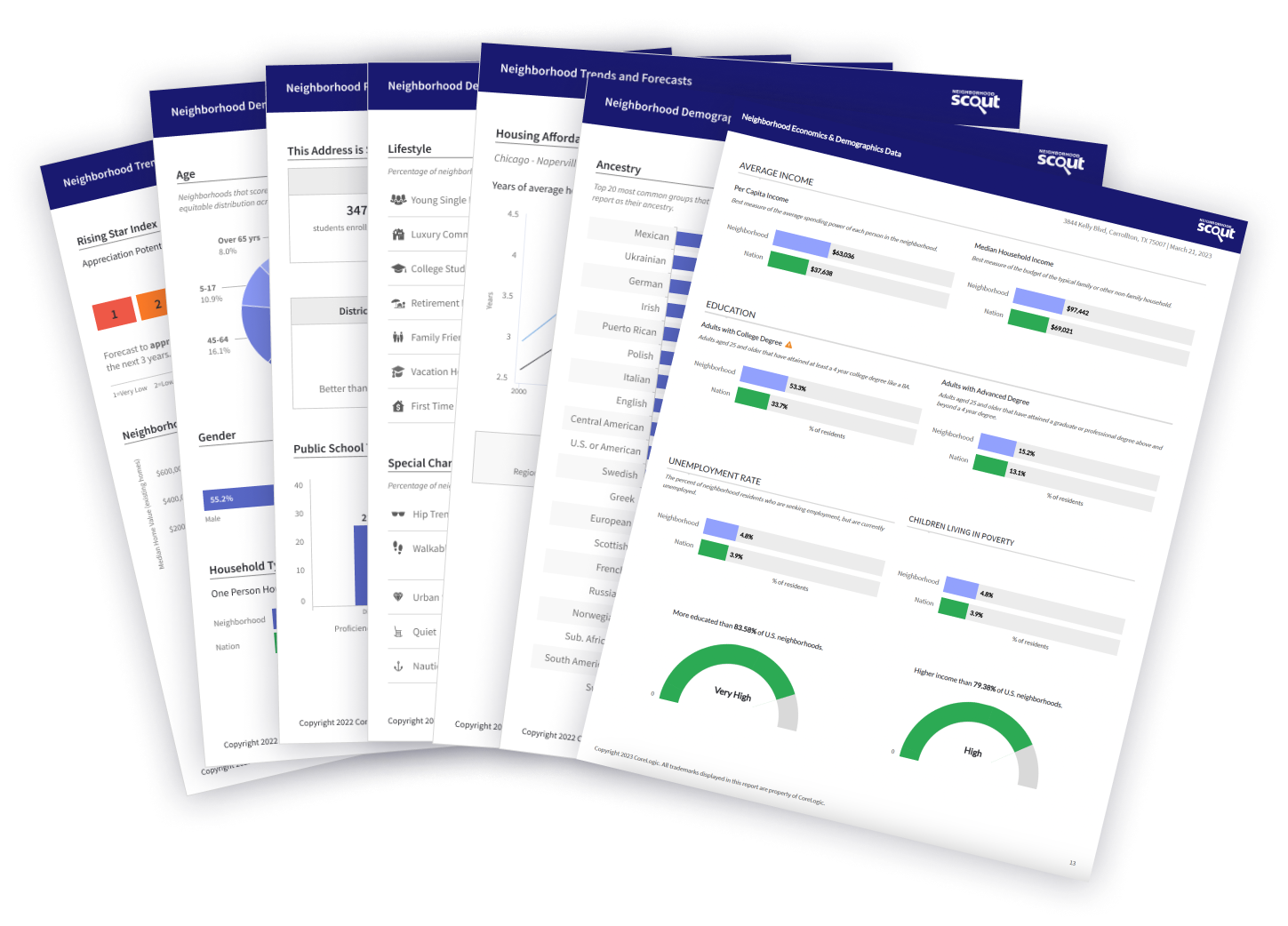
This is a small community in a single neighborhood.
As throughout the site, some neighborhood-level data are reserved for subscribers.
What do we mean by a neighborhood?
NeighborhoodScout® uses the official government designation for neighborhoods - the census tract.
Census tracts are small, relatively permanent subdivisions of a county that are defined by the U.S. Census Bureau in conjunction with local authorities all across the country to define real neighborhoods that are bounded to contain areas with homogeneous population characteristics (including economic status, lifestyle, and living conditions). Census tracts usually have 4,000 persons, but can range between 1,500 and 8,000 persons. This is the most fine-grained area for which detailed information is made available from the government, to protect the individual privacy of each of us. Because census tracts are based on population, they vary in size depending on the density of settlement. In urban areas, they are small, and in rural areas they can cover an entire small town or even a few small towns in very rural areas.
Since census tracts are subdivisions of a county, we did a spatial overlay of the census tracts onto city and town boundaries using a geographic information system to properly assign each census tract to its appropriate city or town. Then we named each census tract to the local colloquially recognized neighborhood name for that spot (e.g., Boston, MA (Dorchester). If there was not a name available, we named the census tract by the largest street intersection in the census tract (e.g., Worcester, MA (Lincoln St/Plantation St)
Why we don't use Zip Codes as neighborhoods
Zip codes were developed by the Postal Service for the purpose of delivering mail, but were never intended to define coherent neighborhoods. In addition, Zip Codes can have as many as 10 distinctly different census tracts contained within them. When distinct census tracts are blended together in a single Zip Code, the data reflects their average conditions and often gives a false sense of the area. The result is that potentially great matching neighborhoods can be missed, and erroneous matches can also be produced and delivered to you.
Using census tracts makes great matches possible, and helps people find the areas that are best for them and their families. Because we are committed to providing the highest possible quality and finding the neighborhoods that best meet your criteria, we use census tracts. And, as always, we show you the actual street map of the neighborhood so you know exactly where your best matching neighborhood is located.
What is a Condition Alert?
A condition alert is a condition in the neighborhood that triggers an alert. NeighborhoodScout contains condition alerts to highlight conditions that are extreme, whether good or bad. This helps answer crucial questions about the state of the neighborhood being evaluated, such as:
What are the risks of violent crime here?
Is the risk of home break-ins or other property crimes increasing?
Does real estate here hold its value?
Are the trends in local vacancies or unemployment concerning?
...and dozens more.
Information at a glance that you need to know to invest, appraise or finance a property.
St. Marks is a tiny coastal city (i.e. on the ocean, a bay, or inlet) located in the state of Florida. With a population of 312 people and just one neighborhood, St. Marks is the 483rd largest community in Florida. St. Marks has seen a significant amount of newer housing growth in recent years. Quite often, new home construction is the result of new residents moving in who are middle class or wealthier, attracted by jobs, a healthy local economy, or other amenities as they leave nearby or far away areas for greener pastures. This seems to be the case in St. Marks, where the median household income is $57,083.00.
Occupations and Workforce
Unlike some cities, St. Marks isn’t mainly white- or blue-collar. Instead, the most prevalent occupations for people in St. Marks are a mix of both white- and blue-collar jobs. Overall, St. Marks is a city of construction workers and builders, sales and office workers, and managers. There are especially a lot of people living in St. Marks who work in sales jobs (23.81%), business and financial occupations (13.10%), and office and administrative support (5.95%).
Of important note, St. Marks is also a city of artists. St. Marks has more artists, designers and people working in media than 90% of the communities in America. This concentration of artists helps shape St. Marks’s character.
Setting & Lifestyle
Overall, St. Marks’s crime rate is one of the lowest in the nation, which makes a great place to live if safety is an important concern.
Residents will find that the city is relatively quiet. This is because it is not over-populated, and it has fewer college students, renters, and young children - all of whom can be noisy at times. So, if you're looking for a relatively peaceful place to live, St. Marks is worth considering.
St. Marks is also nautical, which means that parts of it are somewhat historic and touch the ocean or tidal bodies of water, such as inlets and bays. Quite often, nautical areas such as these attract visitors and locals who come to enjoy the scenery and various waterfront activities.
One downside of living in St. Marks is that it can take a long time to commute to work. In St. Marks, the average commute to work is 41.57 minutes, which is quite a bit higher than the national average.
Being a small city, St. Marks does not have a public transit system used by locals to get to and from work.
Demographics
St. Marks ranks among the bottom of the nation in terms of college education compared to other cities and towns: only 3.46% of people over 25 have a college degree.
The per capita income in St. Marks in 2022 was $28,544, which is lower middle income relative to Florida and the nation. This equates to an annual income of $114,176 for a family of four.
The people who call St. Marks home describe themselves as belonging to a variety of racial and ethnic groups. The greatest number of St. Marks residents report their race to be White. Important ancestries of people in St. Marks include Irish, English, German, Polish, and French.
The most common language spoken in St. Marks is English. Other important languages spoken here include Italian and Russian.
Notable & Unique Neighborhood Characteristics
When you see a neighborhood for the first time, the most important thing is often the way it looks, like its homes and its setting. Some places look the same, but they only reveal their true character after living in them for a while because they contain a unique mix of occupational or cultural groups. This neighborhood is very unique in some important ways, according to NeighborhoodScout's exclusive exploration and analysis.
Real Estate
Unpopulated, and rural, the neighborhood is one of the least crowded neighborhoods in all of America. If you like open space, no traffic, and lots of room, this neighborhood may be just what you are looking for. According to NeighborhoodScout's leading research, this neighborhood is less densely populated than 91.6% of the neighborhoods in America. Do you like a coastal setting? If so, this neighborhood may be to your liking. The neighborhood is on the ocean, a bay, or inlet. Often such coastal places have amenities and recreational activities on the waterfront that are attractive to residents and visitors alike. In addition to being coastal, is a very nautical neighborhood, meaning that it is somewhat historic, walkable, densely populated and on the water. This gives the neighborhood a very nautical feel, with some seaside and shipping feel, which some may really enjoy the sights and sounds of.
People
Divorcees may find friendship and understanding in this neighborhood, as 20.4% of its residents are divorced. NeighborhoodScout's exclusive analysis found that this divorce rate is higher than in 96.1% of the neighborhoods in America.
Diversity
Did you know that the neighborhood has more Eastern European and Scots-Irish ancestry people living in it than nearly any neighborhood in America? It's true! In fact, 4.1% of this neighborhood's residents have Eastern European ancestry and 4.3% have Scots-Irish ancestry.
The Neighbors
There are two complementary measures for understanding the income of a neighborhood's residents: the average and the extremes. While a neighborhood may be relatively wealthy overall, it is equally important to understand the rate of people - particularly children - who are living at or below the federal poverty line, which is extremely low income. Some neighborhoods with a lower average income may actually have a lower childhood poverty rate than another with a higher average income, and this helps us understand the conditions and character of a neighborhood.
The neighbors in the neighborhood in St. Marks are middle-income, making it a moderate income neighborhood. NeighborhoodScout's exclusive analysis reveals that this neighborhood has a higher income than 47.9% of the neighborhoods in America. In addition, 5.0% of the children seventeen and under living in this neighborhood are living below the federal poverty line, which is a lower rate of childhood poverty than is found in 64.0% of America's neighborhoods.
The old saying "you are what you eat" is true. But it is also true that you are what you do for a living. The types of occupations your neighbors have shape their character, and together as a group, their collective occupations shape the culture of a place.
In the neighborhood, 53.5% of the working population is employed in executive, management, and professional occupations. The second most important occupational group in this neighborhood is sales and service jobs, from major sales accounts, to working in fast food restaurants, with 21.8% of the residents employed. Other residents here are employed in manufacturing and laborer occupations (15.8%), and 9.0% in clerical, assistant, and tech support occupations.
Languages
The most common language spoken in the neighborhood is English, spoken by 94.3% of households. Some people also speak Italian (3.6%).
Ethnicity / Ancestry
Culture is shared learned behavior. We learn it from our parents, their parents, our houses of worship, and much of our culture – our learned behavior – comes from our ancestors. That is why ancestry and ethnicity can be so interesting and important to understand: places with concentrations of people of one or more ancestries often express those shared learned behaviors and this gives each neighborhood its own culture. Even different neighborhoods in the same city can have drastically different cultures.
In the neighborhood in St. Marks, FL, residents most commonly identify their ethnicity or ancestry as English (13.1%). There are also a number of people of Irish ancestry (10.5%), and residents who report German roots (8.2%), and some of the residents are also of Scots-Irish ancestry (4.3%), along with some Eastern European ancestry residents (4.1%), among others.
Getting to Work
How you get to work – car, bus, train or other means – and how much of your day it takes to do so is a large quality of life and financial issue. Especially with gasoline prices rising and expected to continue doing so, the length and means of one's commute can be a financial burden. Some neighborhoods are physically located so that many residents have to drive in their own car, others are set up so many walk to work, or can take a train, bus, or bike. The greatest number of commuters in neighborhood spend between 45 minutes and one hour commuting one-way to work (46.0% of working residents), longer and tougher than most commutes in America.
Here most residents (77.1%) drive alone in a private automobile to get to work. In addition, quite a number also carpool with coworkers, friends, or neighbors to get to work (6.4%) . In a neighborhood like this, as in most of the nation, many residents find owning a car useful for getting to work.
SCOUT’s patented match algorithm identifies the most similar neighborhoods to a subject location, and quantifies the similarity to the subject location. This allows analysts to identify the most similar neighborhoods in a local market area for appraisals, investments, and research.
The algorithm uses 273 neighborhood conditions, identifies the dominant dimensions underlying the conditions and calculates the similarity. This captures the true culture and character of locations, economic conditions, and trends.
The closer to 100% means the locations are nearly identical. 80% is a very good, but not excellent match, and so forth.